---
title: Overlap with known SV
description: See how structural variants overlap with known SVs from ClinVar, Decipher, DGV, and other datasets to support pathogenicity assessment in CNV analysis.
---
[Skip to content](https://docs.varsome.com/en/overlap-with-known-sv#main-content)
English
Show submenu for translations
[Submit a Support Request](https://docs.varsome.com/en/kb-tickets/new?hsLang=en) [Customer portal](https://docs.varsome.com/support-requests?hsLang=en)
[![varsome-new.png\]](https://docs.varsome.com/hs-fs/hubfs/varsome-new.png?height=40&name=varsome-new.png)](https://docs.varsome.com/en?hsLang=en)
- Editions
Show submenu for Editions
- [VarSome.com](https://landing.varsome.com/varsome)
- [VarSome Clinical](https://landing.varsome.com/varsome-clinical)
- [VarSome Premium](https://landing.varsome.com/varsome-premium)
- [VarSome API](https://landing.varsome.com/varsome-api)
- [VarSome Insights](https://landing.varsome.com/varsome-insights)
- About
Show submenu for About
- [The Company](https://saphetor.com/)
- [Contact Us](https://landing.varsome.com/contact)
- [Distributors](https://landing.varsome.com/distributors)
- [Become a Partner](https://landing.varsome.com/become-varsome-partner)
- [Community](https://varsome.com/community-contributions/)
- [Cite VarSome!](https://varsome.com/about/general/varsome-citations/)
- Resources
Show submenu for Resources
- [Datasources](https://varsome.com/datasources/)
- [Germline Classification](https://varsome.com/about/resources/germline-implementation/)
- [Somatic Classification](https://varsome.com/about/resources/somatic-implementation/)
- [CNV Classification](https://varsome.com/about/resources/sv-implementation/)
- [Help Center](https://docs.varsome.com/)
- [Library](https://landing.varsome.com/whitepapers)
- [IVDR](https://landing.varsome.com/ivdr-whitepaper)
- [Legal & Compliance](https://docs.varsome.com/en/legal-compliance)
- Blog
Show submenu for Blog
- [Platform Updates](https://updates.varsome.com/en)
- [Company News](https://news.varsome.com/en)
- [VarSome Annotated](https://blog.varsome.com/annotated)
Open main navigation
Close main navigation
- Editions
Show submenu for Editions
- [VarSome.com](https://landing.varsome.com/varsome)
- [VarSome Clinical](https://landing.varsome.com/varsome-clinical)
- [VarSome Premium](https://landing.varsome.com/varsome-premium)
- [VarSome API](https://landing.varsome.com/varsome-api)
- [VarSome Insights](https://landing.varsome.com/varsome-insights)
- About
Show submenu for About
- [The Company](https://saphetor.com/)
- [Contact Us](https://landing.varsome.com/contact)
- [Distributors](https://landing.varsome.com/distributors)
- [Become a Partner](https://landing.varsome.com/become-varsome-partner)
- [Community](https://varsome.com/community-contributions/)
- [Cite VarSome!](https://varsome.com/about/general/varsome-citations/)
- Resources
Show submenu for Resources
- [Datasources](https://varsome.com/datasources/)
- [Germline Classification](https://varsome.com/about/resources/germline-implementation/)
- [Somatic Classification](https://varsome.com/about/resources/somatic-implementation/)
- [CNV Classification](https://varsome.com/about/resources/sv-implementation/)
- [Help Center](https://docs.varsome.com/)
- [Library](https://landing.varsome.com/whitepapers)
- [IVDR](https://landing.varsome.com/ivdr-whitepaper)
- [Legal & Compliance](https://docs.varsome.com/en/legal-compliance)
- Blog
Show submenu for Blog
- [Platform Updates](https://updates.varsome.com/en)
- [Company News](https://news.varsome.com/en)
- [VarSome Annotated](https://blog.varsome.com/annotated)
- English
Show submenu for translations
- [Submit a Support Request](https://docs.varsome.com/en/kb-tickets/new)
- [Customer portal](https://docs.varsome.com/support-requests)
- [Contact us](https://docs.varsome.com/en/kb-tickets/new)
[Contact us](https://docs.varsome.com/en/kb-tickets/new?hsLang=en)
How can we help you?
- There are no suggestions because the search field is empty.
1. [VarSome Help Center](https://docs.varsome.com/en?hsLang=en)
2. [Analysis of the results](https://docs.varsome.com/en/analysis-of-the-results?hsLang=en)
3. [Results](https://docs.varsome.com/en/analysis-of-the-results?hsLang=en#results)
# Overlap with known SV
### **Overview**
VarSome Clinical now displays the percentage overlap with known structural variants (SVs) in a dedicated column within the SV table. Known SVs are retrieved from several data sources, like ClinVar, Decipher, DGV, dbVar, Children’s Mercy research institute, Ira Hall Lab, HPRC, and estd20.
This feature is available for CNV analysis from WGS, WES, as well as tertiary SV analysis from VCF files.
### **Key functionality:**
- The “**Overlap with Known SVs**” column provides an at-a-glance assessment of how a user’s SV overlaps with previously reported benign or pathogenic SVs of the same CNV type (deletions or duplications).
- For each SV, the column reports the highest available overlap percentage and enables interpretation based on the inferred pathogenicity derived from genomic overlap, including gene and exon-level overlap.
- Users can filter SVs based on the inferred pathogenicity indicated by the overlap with known SVs.
- Users can navigate directly to the corresponding Known SVs card to review the referenced known SV in detail, as well as explore all other variants that overlap with the user’s SV.
### **Overlap with Known SV column**
This section describes the information displayed in the “**Overlap with Known SVs**” column and explains how to filter results based on the predicted pathogenicity derived from the overlap percentage.
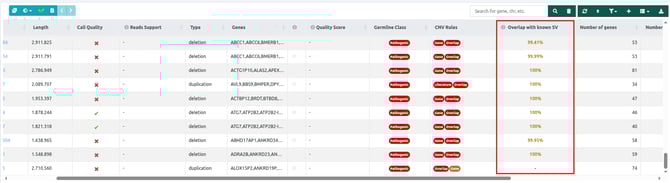
An overlap threshold of ≥70% is applied to determine meaningful matches. This threshold enables a more accurate functional-level comparison, including gene and exon overlap, thereby improving the reliability of pathogenicity inference based on structural variant overlap.
[](https://docs.varsome.com/hubfs/image-png-Feb-27-2026-07-05-55-1549-AM.png?hsLang=en)
The column shows the overlap percentage of the user SV (duplication or deletion) with the known SV. the color is based on the predicted pathogenicity of the user SV based on overlap with the known SV :
- **Green scale:** the SV fully overlaps with a known benign or likely benign SV, or contains a benign or likely benign SV with full genes and exon overlap; the variant is inferred to be benign or likely benign.
- **Red scale**: the SV fully overlaps or contains a known pathogenic or likely pathogenic or SV, the variant is inferred to be pathogenic or likely pathogenic.
- **Yellow:** the SV overlaps with a known benign, pathogenic SV but no pathogenicity inference can be made due to partial genes and/or exons overlap; or the SV overlaps with a known uncertain significance or an unclassified SV.
When hovering over an overlap percentage, users can review detailed information about the overlapping known SV, including whether the overlap is with a pathogenic, benign, or variant of uncertain significance (VUS) SV. The tooltip also displays the genomic coordinates of the known SV, the data source from which it is annotated, the extent of gene and exon overlap (full or partial), and the structural relationship between the variants (e.g., identical genomic coordinates or one SV contained within the other).
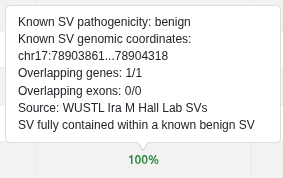
The Known SV displayed in the column corresponds to the variant with the highest overlap percentage among all overlapping known SVs. Selection is prioritized by pathogenicity (pathogenic\>VUS\>benign), and when overlap percentages are identical, prioritization follows this order:
1. ClinVar CNVs
2. Decipher
3. GnomAD
4. DGV
5. Estd20
6. dbVar
7. Ira M Hall
8. HPRC
9. Children’s Marcy
### **Filtering based on the overlap with known SVs**
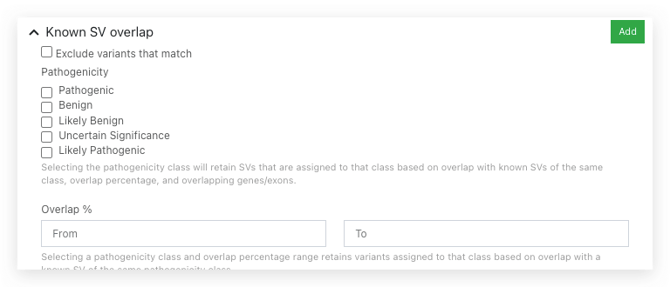
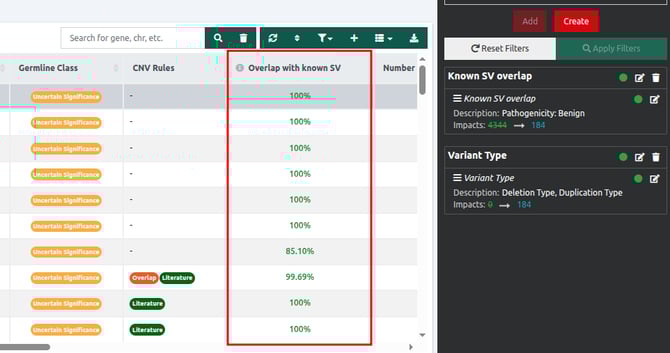
A filter is available to select SVs based on the predicted pathogenicity inferred from overlap with known SVs of the same class. Users can also define a custom range of overlap percentages to retain in the results.
[](https://docs.varsome.com/hubfs/undefined-Feb-27-2026-07-13-32-6202-AM.png?hsLang=en)
[](https://docs.varsome.com/hubfs/image-png-Feb-27-2026-07-17-04-6280-AM.png?hsLang=en)
Applying the above filter to retain SVs predicted as benign based on overlap helps exclude variants classified as VUS, thereby streamlining downstream analysis and variant interpretation.
### **Overlap with known SV card**
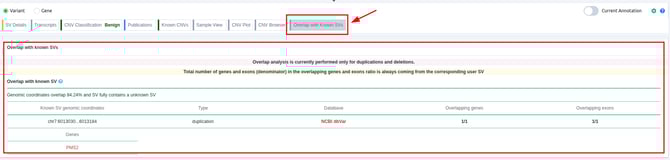
The Overlap with Known SVs card provides detailed information about the known SV displayed in the column, as well as all other known SVs that overlap with the user’s SV at lower percentages. In addition, the card lists all overlapping genes for each known SV overlap, allowing users to directly review gene-related clinical information in VarSome.
[](https://docs.varsome.com/hubfs/image-png-Mar-12-2026-11-36-09-0034-AM.png?hsLang=en)
- [Registration & Billing](https://docs.varsome.com/en/registration-billing?hsLang=en#main-content)
- [User account management](https://docs.varsome.com/en/registration-billing?hsLang=en#user-account-management)
- [Storage management](https://docs.varsome.com/en/registration-billing?hsLang=en#storage-management)
- [Pricing and Billing](https://docs.varsome.com/en/registration-billing?hsLang=en#pricing-and-billing)
- [VarSome Clinical Tokens](https://docs.varsome.com/en/registration-billing?hsLang=en#varsome-clinical-tokens)
- [Management of Samples and Analyses](https://docs.varsome.com/en/management-of-samples-and-analyses?hsLang=en#main-content)
- [Uploading files](https://docs.varsome.com/en/management-of-samples-and-analyses?hsLang=en#uploading-files)
- [Managing Samples](https://docs.varsome.com/en/management-of-samples-and-analyses?hsLang=en#managing-samples)
- [Managing Workflows](https://docs.varsome.com/en/management-of-samples-and-analyses?hsLang=en#managing-workflows)
- [Launching analyses](https://docs.varsome.com/en/management-of-samples-and-analyses?hsLang=en#launching-analyses)
- [Analysis of the results](https://docs.varsome.com/en/analysis-of-the-results?hsLang=en#main-content)
- [Analyses](https://docs.varsome.com/en/analysis-of-the-results?hsLang=en#analyses)
- [Results](https://docs.varsome.com/en/analysis-of-the-results?hsLang=en#results)
- [Filters](https://docs.varsome.com/en/analysis-of-the-results?hsLang=en#filters)
- [Reporting](https://docs.varsome.com/en/analysis-of-the-results?hsLang=en#reporting)
- [Quality Control](https://docs.varsome.com/en/analysis-of-the-results?hsLang=en#quality-control)
- [Legal & compliance](https://docs.varsome.com/en/legal-compliance?hsLang=en)
- [FAQ & Troubleshooting](https://docs.varsome.com/en/faq-troubleshooting?hsLang=en#main-content)
- [Troubleshooting](https://docs.varsome.com/en/faq-troubleshooting?hsLang=en#troubleshooting)
- [General](https://docs.varsome.com/en/faq-troubleshooting?hsLang=en#general)
- [Filters](https://docs.varsome.com/en/faq-troubleshooting?hsLang=en#filters)
- [User Interface](https://docs.varsome.com/en/faq-troubleshooting?hsLang=en#user-interface)
- [Pipelines](https://docs.varsome.com/en/faq-troubleshooting?hsLang=en#pipelines)
- [Features](https://docs.varsome.com/en/faq-troubleshooting?hsLang=en#features)
- [Scientific articles](https://docs.varsome.com/en/scientific-articles?hsLang=en)
- [VarSome API](https://docs.varsome.com/en/varsome-api?hsLang=en)
[](https://varsome.com)
**Resources**
[Query Examples](https://varsome.com/about/resources/examples/)
[Germline Classification](https://varsome.com/about/resources/germline-implementation/)
[Somatic Classification](https://varsome.com/about/resources/somatic-implementation/)
[White Papers & Other Resources](https://varsome.com/library/)
[Cite VarSome](https://varsome.com/about/general/varsome-citations/)
[System Status](https://status.saphetor.com/)
[Help Center](https://docs.varsome.com/en?hsLang=en)
**Legal**
[Terms of Use](https://varsome.com/information/legal/terms/)
[Privacy Policy](https://varsome.com/information/legal/privacy/)
[Information Security](https://varsome.com/information/legal/information-security/)
Copyright © 2025, Saphetor SA